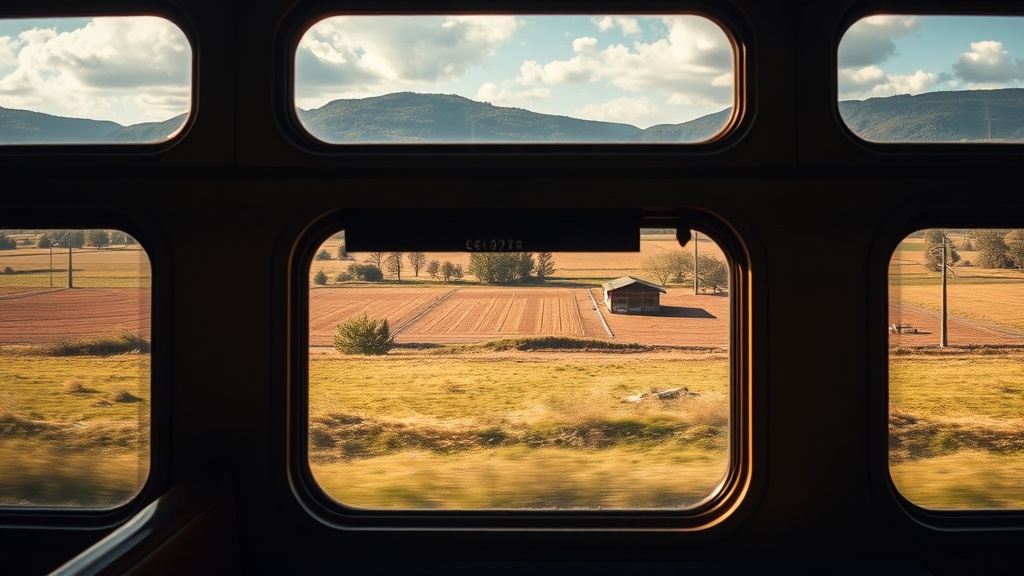
Why Train Windows Still Frame the Most Honest Views of Rural Europe

The Overlooked Renaissance of Rural Rail Travel
Here's something that might surprise you—despite the rise of budget airlines and high-speed motorways, rural train routes across Europe have seen a 23% increase in passenger numbers since 2019. Travelers are quietly rediscovering what previous generations always knew: the countryside reveals itself most honestly through a train window. There's no GPS to follow, no exit ramps to calculate—just the slow unfolding of pastures, villages, and horizons that haven't changed much in a century. This guide covers everything you need to plan a countryside vacation built around regional rail routes—the kind of trip where the getting there becomes the destination itself.
Unlike highways that skirt around towns in favor of efficiency, rural train lines were laid to connect communities. That means your route threads through market squares, past farmhouse kitchens, and alongside rivers where locals still fish. You'll see laundry fluttering from windows in Tuscany, sheepdogs herding flocks in the Welsh Marches, and apple orchards heavy with fruit in Normandy—all from a seat that doesn't require your hands on a steering wheel. The pace is deliberate. You can't rush a rural train, and that's precisely the point.
Why Do Train Routes Reveal a Side of the Countryside Highways Hide?
Highways are engineered for speed and separation. They elevate you above the land, separated by barriers and service stations that look identical whether you're in Portugal or Poland. Rural railways, by contrast, were built in an era when trains were expected to stop at every village worth visiting. The tracks follow valleys rather than cutting through mountains. They hug coastlines instead of retreating inland. You see the back gardens, the industrial yards, the soccer pitches where teenagers practice at dusk—the unedited version of rural life.
Take the Cambrian Coast Railway in Wales, which runs from Shrewsbury to Pwllheli. For much of its route, the tracks sit so close to Cardigan Bay that spray occasionally hits the windows during winter storms. You pass through Harlech with its castle perched impossibly on a rock, through Barmouth where the Victorian railway bridge carries you across the estuary at tide level, and past beaches where you'll see more seals than people. No road offers this intimacy with the landscape.
Or consider the TER lines through rural Languedoc, connecting Toulouse to Narbonne and onward to the Spanish border. These trains climb into the Corbières hills, tunnel through limestone cliffs, and emerge into valleys where Cathar castles crown rocky outcrops. The journey from Carcassonne to Quillan takes just over an hour but transports you into a landscape that feels decades removed from the modern world. Vineyards give way to oak forests. Small stations still have stationmasters who know most passengers by name.
What Should You Pack for a Multi-Day Rail Adventure Through Rural Regions?
Packing for rural train travel requires a different mindset than preparing for a city break or a resort vacation. Space matters—you'll be carrying everything through stations that may lack elevators, onto platforms that might be gravel rather than concrete, and onto trains where luggage racks are designed for briefcases rather than rolling suitcases. A 40-liter backpack beats a hard-shell roller every time.
Bring layers regardless of season. Rural trains are notorious for erratic heating and cooling systems. The same carriage that feels tropical in the afternoon might feel refrigerated by evening. A light wool sweater, a packable down jacket, and a scarf that can double as a pillow will serve you better than one heavy coat. Comfortable walking shoes are non-negotiable—many rural stations are miles from the villages they serve, and you'll likely face hills, cobblestones, or muddy lanes between the platform and your accommodation.
Pack provisions thoughtfully. While major routes have dining cars, rural lines rarely do. A reusable water bottle, some local cheese and bread purchased at a market, and a few pieces of fruit will keep you content during long stretches between stops. Don't forget a physical map—mobile service disappears in mountain valleys and remote moorlands. A notebook proves surprisingly useful too; you'll want to record station names, recommended restaurants from fellow passengers, and the occasional phone number for a taxi driver who actually answers.
How Can You Build an Itinerary Around Regional Train Schedules?
Here's where most travelers stumble—they plan their countryside vacation as if trains run like London Underground services. Rural routes operate on their own logic. Some lines run only on weekdays. Others offer just three departures daily. A few suspend service entirely during winter months. Building your itinerary requires accepting these constraints as features rather than obstacles.
Start with the railway company's website—not a third-party booking platform. SNCF Connect for France, Trenitalia for Italy, and the various regional operators across Germany and Spain publish timetables months in advance. Study them before booking accommodation. That converted farmhouse in the Dordogne might look perfect, but if the nearest station only receives trains on Tuesdays and Thursdays, you'll need to adjust your plans.
Build buffer time into every transfer. Rural connections often require ten-minute waits that stretch to forty when the first train runs late. Don't panic—this is normal. Use the delay to explore the station town, which is often the most authentic settlement in the region precisely because tourists rush through it. The café across from the platform probably serves coffee to the same farmers every morning. The station bookshop might stock local history titles you won't find in capital city stores.
Consider the rhythm of rural life when planning activities. Morning trains carry commuters and schoolchildren—they're lively but crowded. Midday services tend toward retirees and tourists. Evening trains often host workers returning from distant towns, and the atmosphere shifts accordingly. Some of the best conversations happen on these late services, when locals decompress from their days and sometimes open up to curious strangers.
Where Should You Base Yourself for Maximum Flexibility?
The most successful rural rail itineraries use hub towns as bases rather than trying to see everything in one continuous loop. Find a pleasant market town with good rail connections—places like Albi in southwestern France, Český Krumlov in the Czech Republic, or Keswick in England's Lake District (bus connections extend the rail network here). Rent accommodation for several nights. Take day trips on branch lines, returning to the same bed each evening.
This approach eliminates the stress of dragging luggage onto crowded trains daily. It lets you unpack, establish routines, and actually get to know a place. The bakery where you buy your morning croissant becomes familiar. The bartender remembers your preference for local beer. These small repetitions—what the French call la vie quotidienne—reveal more about countryside living than any museum or guided tour.
What About the Practical Details No One Mentions?
Rural stations often lack staff. You might need to validate your ticket using a yellow composting machine on the platform—miss this step in France or Italy and you could face a fine even with a valid ticket. Some lines require reservations during summer months despite being regional services. Others operate on a honor system where inspectors check tickets randomly rather than at barriers.
Toilets on older rural trains can be... rustic. Carry tissue paper and hand sanitizer. Announcements might come only in local dialects or not at all—keep track of stops using your map and the station signs visible from the window. When in doubt, ask fellow passengers. Rural train communities are generally helpful, and attempting a few words in the local language goes further than you'd expect.
Weather affects rural rail more than mainlines. Floods, landslides, and fallen trees cause delays that can't be quickly resolved when maintenance crews are scattered across vast territories. Build flexibility into your plans. That castle visit might need to shift from Tuesday to Thursday. The walking route you mapped might require modification if the connecting bus isn't running. Adaptability isn't just useful for rural rail travel—it's the whole philosophy.
There's something quietly revolutionary about choosing the slower path. While the world accelerates toward efficiency and optimization, rural train travel stubbornly resists both. It demands patience. It rewards attention. It connects you not just to places, but to the people who live in them—the farmer checking his phone beside a field of sunflowers, the elderly couple sharing sandwiches wrapped in wax paper, the student practicing violin in an empty carriage as the evening light fades over distant hills. These moments don't appear on itineraries. They can't be booked or purchased. They simply arrive, unannounced, through windows that frame the countryside as it actually is—unfiltered, unhurried, and entirely worth the extra hours.